
How To Find Winning Performance Ads Without Wasting Budget On In-Flight Testing
by Liam O'Dowd in
10 min read
Traditional performance marketing wastes 10-20% of campaign budgets testing creative on live platforms.
This experiment proves a better way exists: pre-test ads with real consumers before spending a penny on campaigns.
By testing three D2C brands with matched audiences in Loops before launch, we achieved:
• 235% average increase in conversions
• 43% reduction in cost per click
• 205% increase in conversion rate
• Zero wasted ad spend during learning phase
For a £50,000 campaign, this approach eliminates £5k-£10k in sunk testing costs while delivering dramatically better results from day one. The question isn't whether you can afford to pre-test creative – it's whether you can afford not to.
Testing is the beating heart of performance marketing. Ever since the internet was monetised with banner ads, digital marketers have been searching for the optimal variations of their adverts to find out which one delivers the best results, and ultimately, the greatest ROI.
It’s a methodology that has changed little in the last few decades. At its simplest form, marketers will use an A/B test, or split test. Create one version of an ad, and then create a variant with some changes. Spend some of your budget running both ads to see which produces the best results and, once you have a winner, spend the rest of your budget on the winning ad.
Traditional approach: Launch → Spend Money → Learn → Optimize
This method is time-tested because it works across formats – from images to video, text to audio – but it’s also wasteful. Imagine an illustrative budget of £50,000 for a campaign selling hoverboards. It isn’t uncommon for a marketing team to spend 10-20% of that budget in a learning phase to understand which set of ads perform best, before putting the rest of the budget behind the highest performing set. This leads to a sunk cost of £5k-£10k in the learning phase before knowing which ads work well with their target audience to sell the most hoverboards.
In this scenario, there is only one winner – the advertising platform running the ads. Uncertainty about creative performance works in their favour. Every campaign launched brings more revenue for them, while marketing teams work out which ads are likely to deliver a better overall ROI. For brands that rely on ongoing performance spend, this is a sunk cost that eats into annual budgets time after time, building waste into strategy.
AB testing
This sunk cost on creative testing is an accepted part of performance marketing strategy, whether it involves a simple A/B split test of two variations or a more complex range of creatives across multiple channels. As Generative AI rapidly improves, brands now have the opportunity to roll out massive variations of ad creative at scale. Yet the ability to increase volume comes with a caveat: all of that additional volume requires testing to find the winning ads; you can’t just spray and pray. All of that testing comes at a cost: more budget given up to the platforms.
A Better Way: Consumer Validation Before Campaign Launch
What if you could validate creative with your exact target audience before spending a single penny on campaigns? What if you could identify winning ads in 48 hours, without giving Meta or Google a cut of your testing budget?
Loops is a testing platform which allows brands, marketers and creatives to get insights on any form of creative work via a global audience of over 110 million consumers, with 150+ built-in demographic filters and custom screening capabilities. It's used by some of the world's leading agencies to get feedback during the creative process, validating decisions to ensure results land each and every time.
Performance marketing is at a fork in the road. Teams can now use AI to build creative at scale and at speed, but all of that extra output requires budget to test and measure. This creates a problem. Is there a way to validate ads without wasting budget? Could pre-testing ads in Loops with a matched audience drastically improve the performance of paid ads before a penny is spent on campaigns?
Loops approach: Research → Optimize → Launch → Win
The Experiment: Three Brands, Real Budgets
To prove whether it was possible to deliver measurable ROI from Loops-optimised ads vs. unoptimised control ads, three dummy D2C brands were created.
Using LLMs, we identified three trending D2C verticals: collagen beauty products, post-workout protein drinks, and modular adaptogen and nootropic supplements.
Building a brand
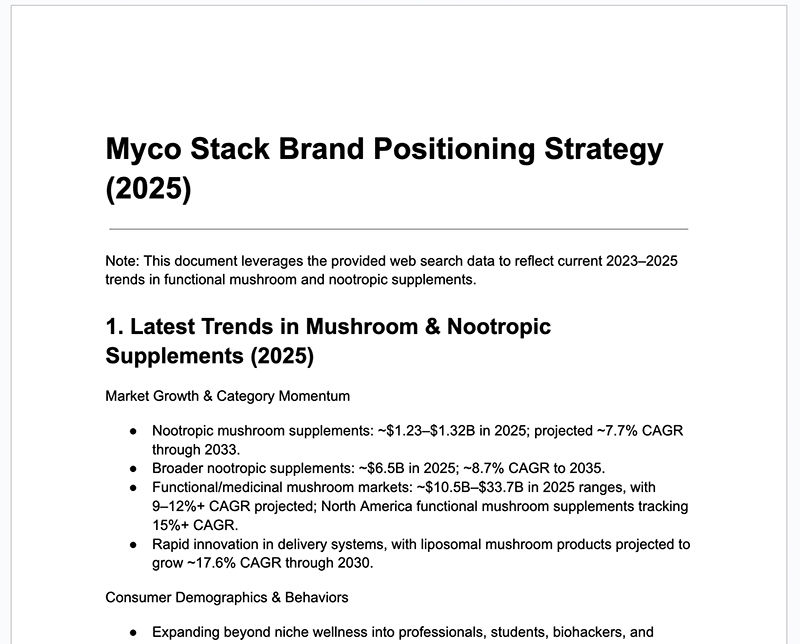
For each brand, a detailed market research and brand positioning document was created. The research analysed trends, identified a customer persona, competitor research and suggested brand identity assets, tone of voice and marketing hooks. This research document was then used to create visual branding assets to define the brand's core identity in line with the research and persona.
From this core brand development, social profiles and assets were created, alongside a series of organic social posts, to support the brand messaging and visual identity.
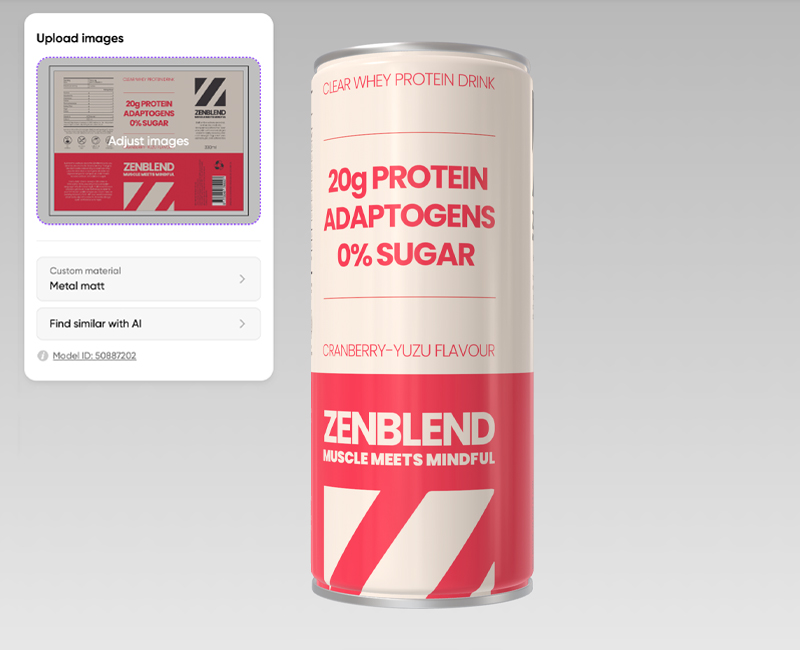
Once the core brand was developed, the assets were used to create mockup products representative of the sort of product each brand might use to launch, or trial in an MVP experiment.
Creating the product renders
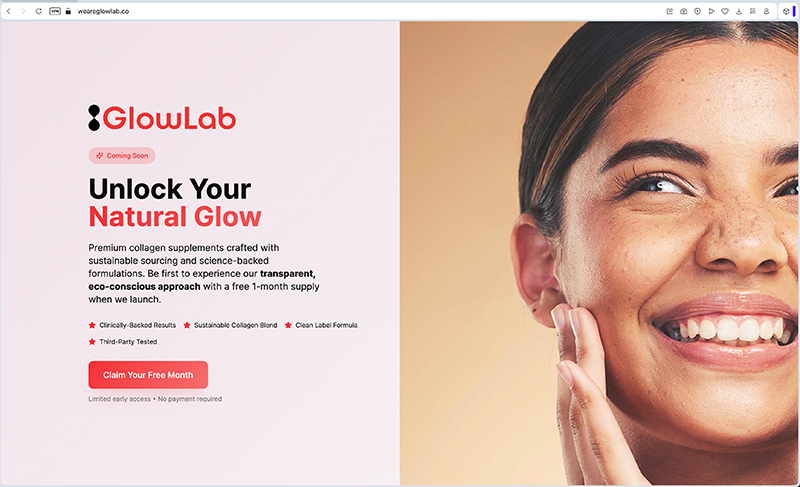
Finally, a coming soon landing page was developed, using the initial research, brand persona and product mockups. Each landing page featured a ‘free trial’ signup offer to create a conversion point that could be measured to assess the overall performance of the control ads vs Loops optimised ads.
Landing page creation
With all brand assets in place. GenAI was used to create a set of control ads and copy, ready to be tested in Loops.
Pre-Testing Process in Loops
To understand the effectiveness of the control ads, tests were set up in Loops, creating an audience that closely matched the target audience defined in the initial brand research document.
Participants were asked a series of questions around the ads, both qualitative and quantitative, to understand what they thought of the ad creative, the copy, and whether the messaging was clear. For each control ad set, 150 responses were gathered and then summarised using the Loops internal AI, collecting summaries for both qual and quant replies, highlighting the three most suitable and/or actionable suggestions.
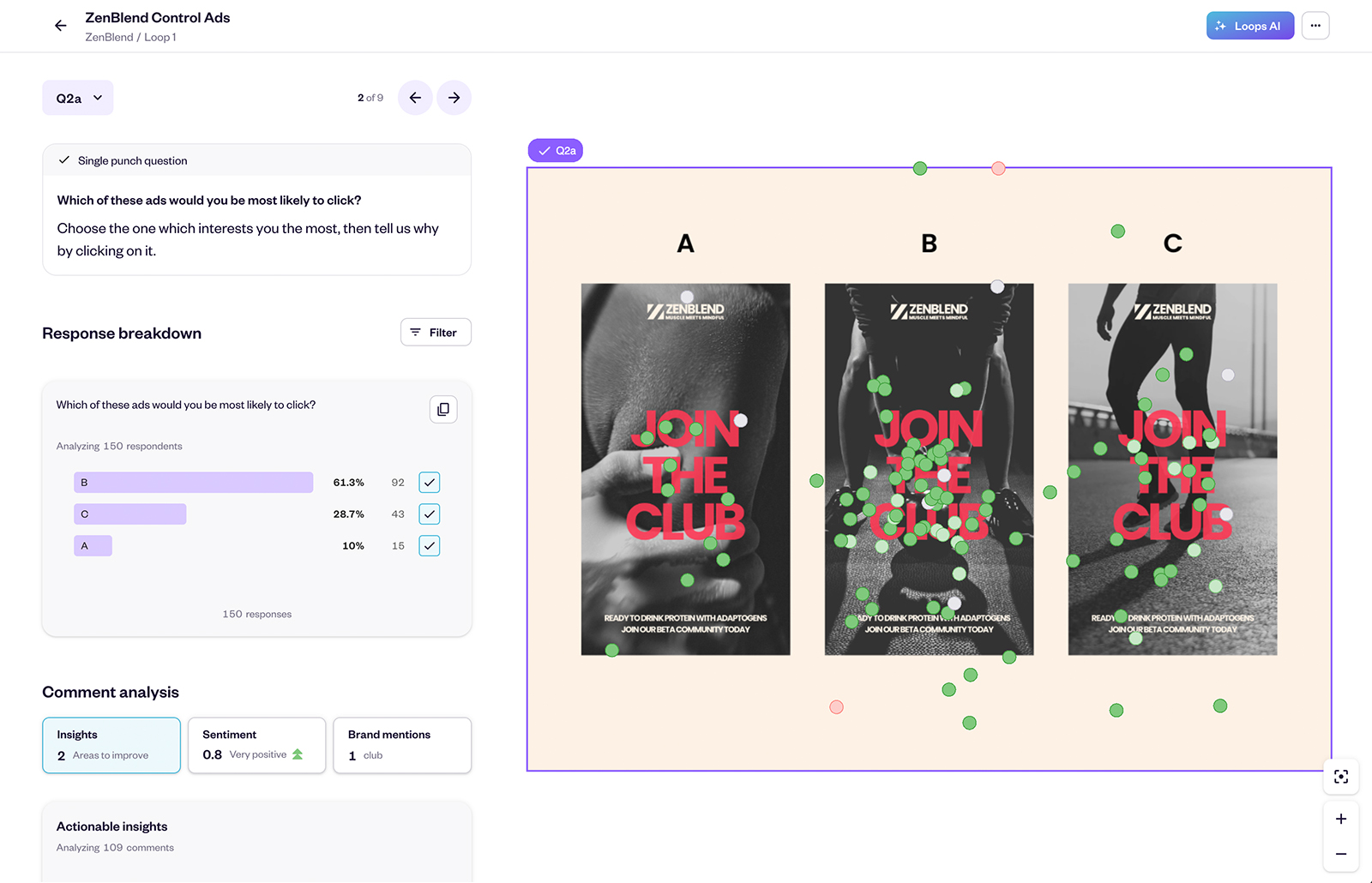
Testing ads inside Loops
Using these suggestions, a set of optimised ads was then created, using the same GenAI templates from the control ad set, but with changes based on audience feedback.
Each ad set was given equal spend alongside matching demographic and audience targeting settings. Ads were run simultaneously for the same period of time, then the results from each ad set were compared at the end of each experiment.
The Experiments
Across all three experiments, Loops was able to increase key performance metrics for each brand. Here's what happened when we let consumers guide creative decisions before launch:
Brand 1 - GlowLab
Platform: Meta
Creative Type: Static image ads, placed in feeds, stories and reels
About: GlowLab is a sustainable collagen supplement brand aimed at 21 - 45 year old women in the UK and US.
Control Ads
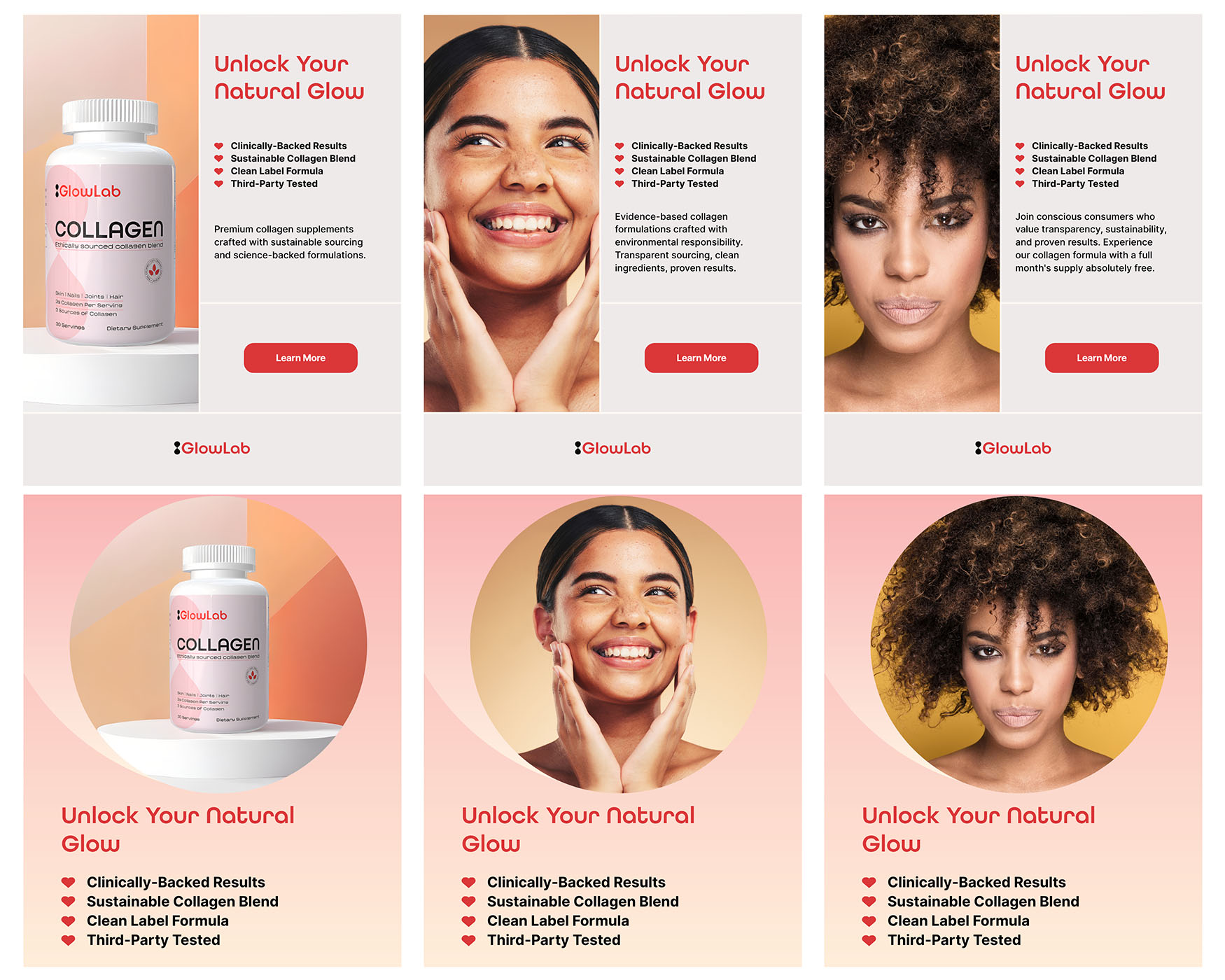
GlowLab control ads
Loops Optimised Ads
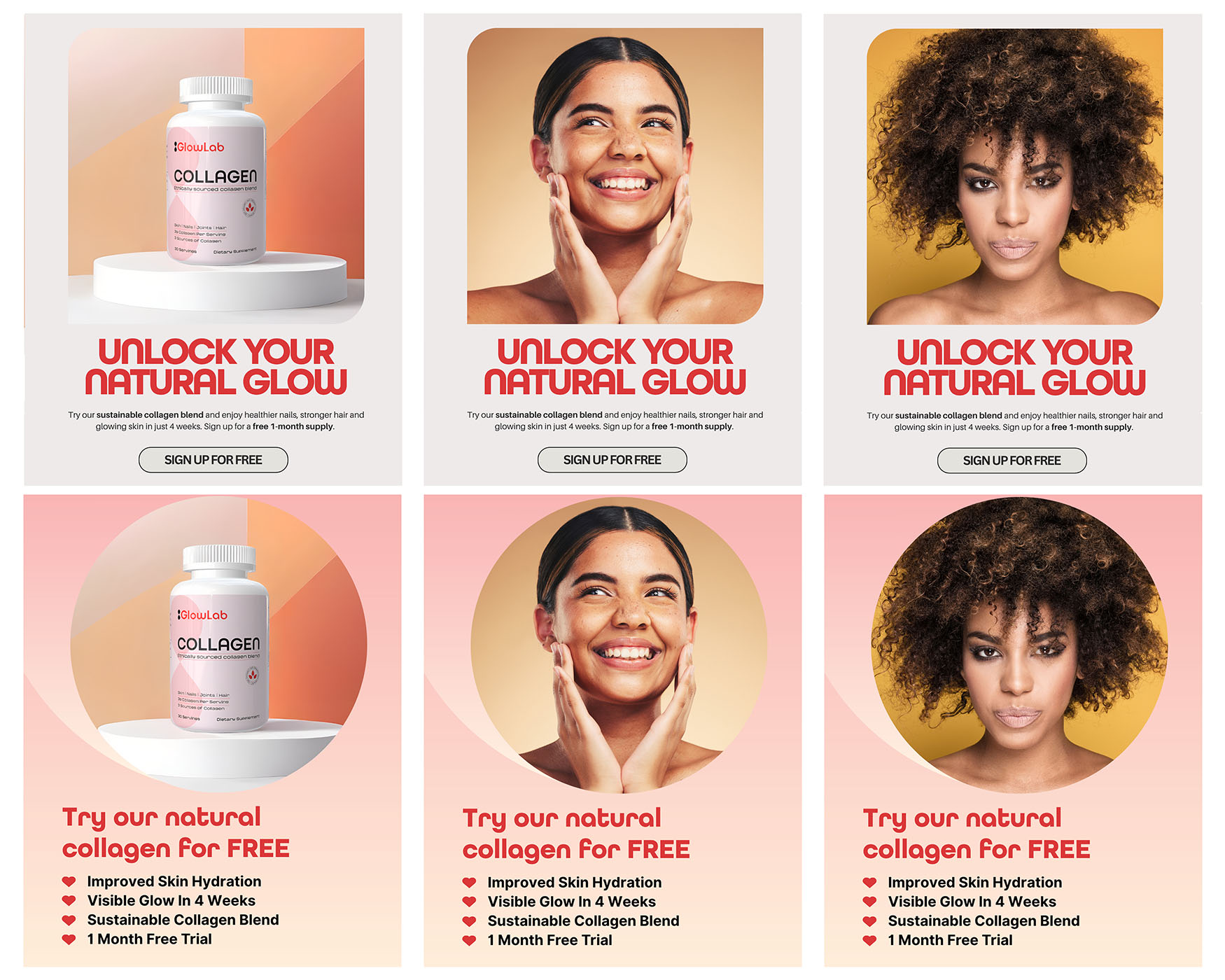
GlowLab optimised ads after Loops testing
In this Loops test, 149 respondents were asked to identify their favourite ad from the control series, and asked to identify how various parts of the ad and accompanying copy could be improved to be more engaging.
Feedback included suggestions to make the offer more prominent, to make the creative less clinical and to reduce copy in the ads to make them clearer.
Impact:
Meta | Impressions | Clicks | CTR | CPC | Conversions | Conv Rate |
Control | 6460 | 131 | 2.03 | £1.30 | 41 | 0.63% |
Optimised | 10165 | 433 | 4.26 | £0.44 | 196 | 1.93% |
378% increase in conversions
66% reduction in CPC
206% increase in conversion rate
Brand 2 - ZenBlend
Platforms: Meta, Google Display
Creative Type: Static image placed in feeds. Google display (non-responsive)
About: ZenBlend is a clear whey & adaptogen post-workout drink aimed at men and women aged 25-45 in the UK and US.
Control Ads
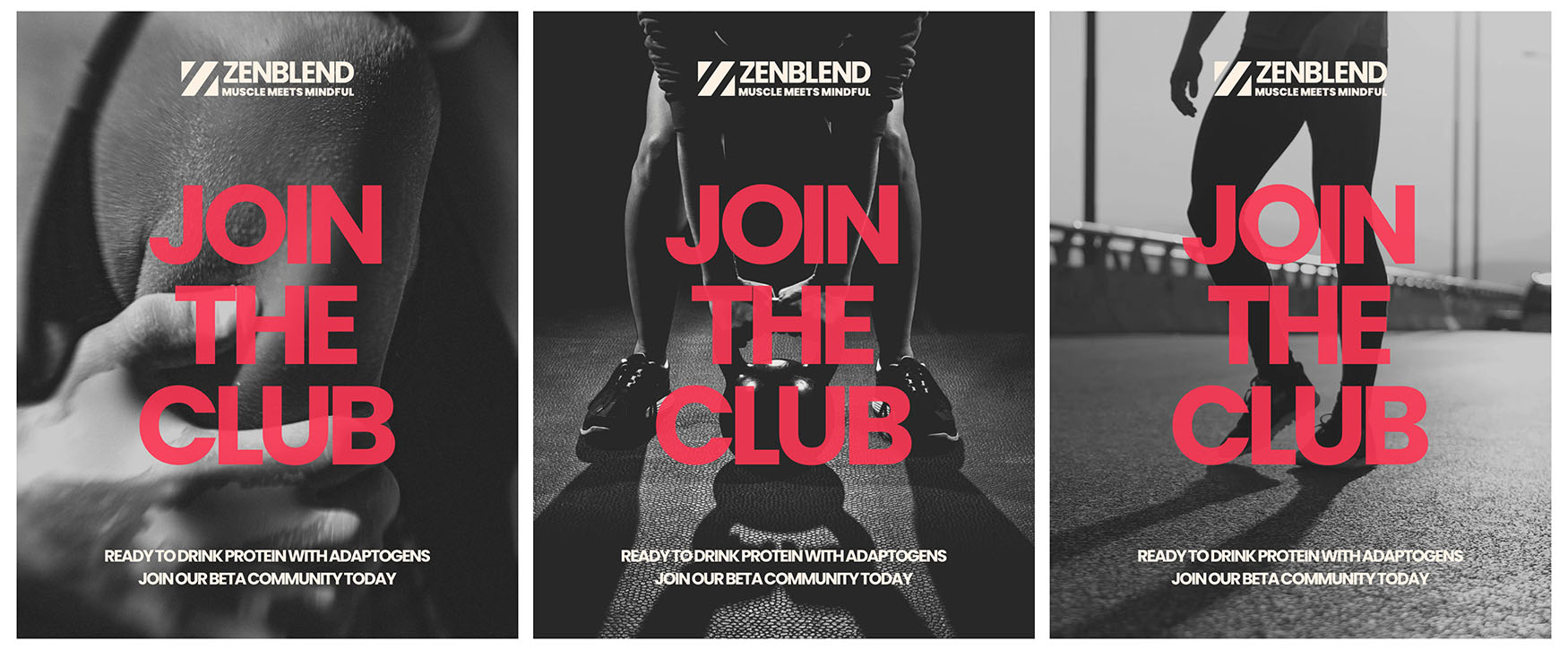
ZenBlend control ads
Loops Optimised Ads
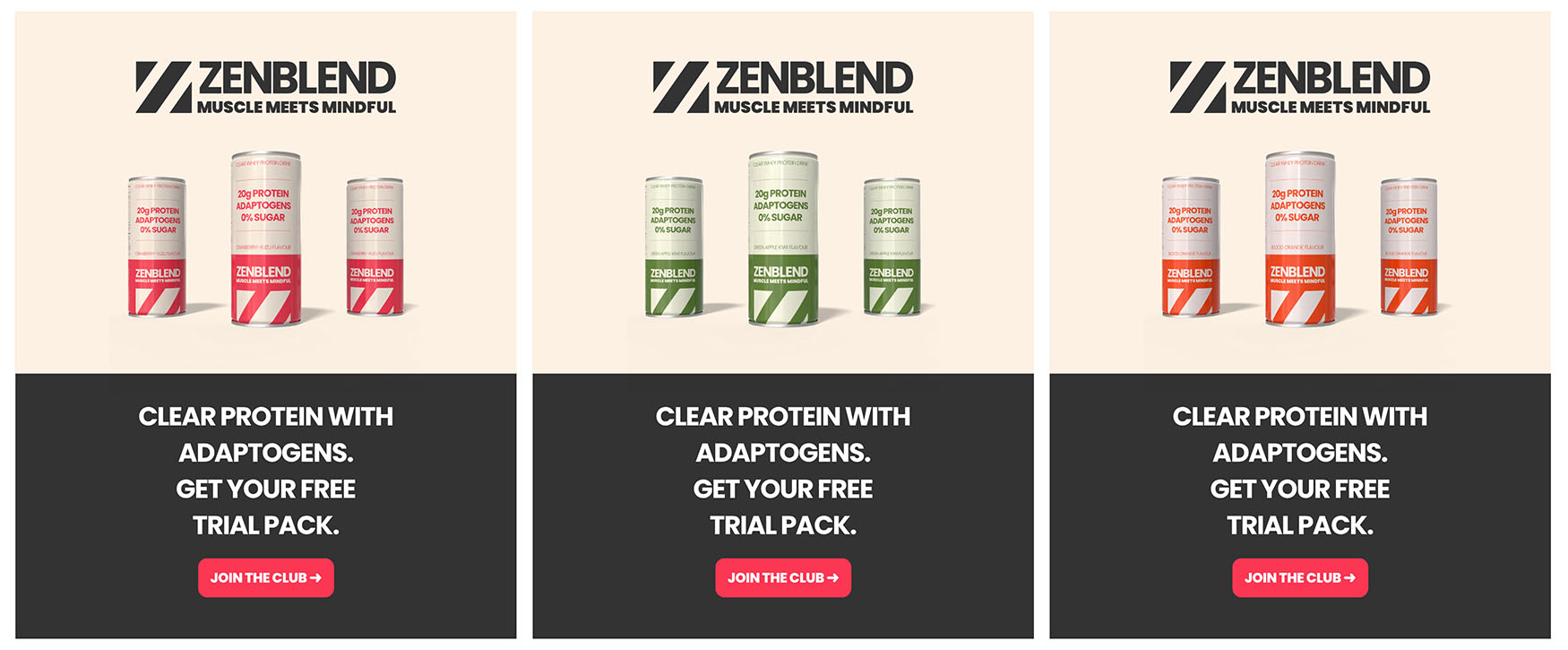
ZenBlend ads after Loops optimisation
For ZenBlend, 150 respondents were shown a sample of creatives from the control series and asked for both qualitative and quantitative responses to assess effectiveness. Respondents were also shown the landing page and asked for feedback on the connection between the ad and the landing page offer.
The results showed that some respondents were not clear on the product, the ingredients or the trial offered, and that the CTA was not compelling enough.
Impact:
(The same design and copy changes were also made across all display placements and sizes)
Meta | Impressions | Clicks | CTR | CPC | Conversions | Conv Rate |
Control | 21,916 | 184 | 0.84% | £1.36 | 41 | 0.19% |
Optimised | 17,056 | 340 | 1.99% | £0.73 | 164 | 0.96% |
Display | Impressions | Clicks | CTR | CPC | CPM |
Control | 262,422 | 1,988 | 0.76% | £0.11 | £0.80 |
Optimised | 253,751 | 2,199 | 0.87% | £0.10 | £0.85 |
300% increase in conversions
46% reduction in CPC
405% increase in conversion rate
14.5% increase in display CTR
Brand 3 - myco•stack
Platforms: Meta
Creative Type: Animated video placed in feeds, reels and stories.
About: myco–stack is a modular nootropic + functional supplement brand aimed at men and women in the UK and US aged 28 - 40.
Control Ads
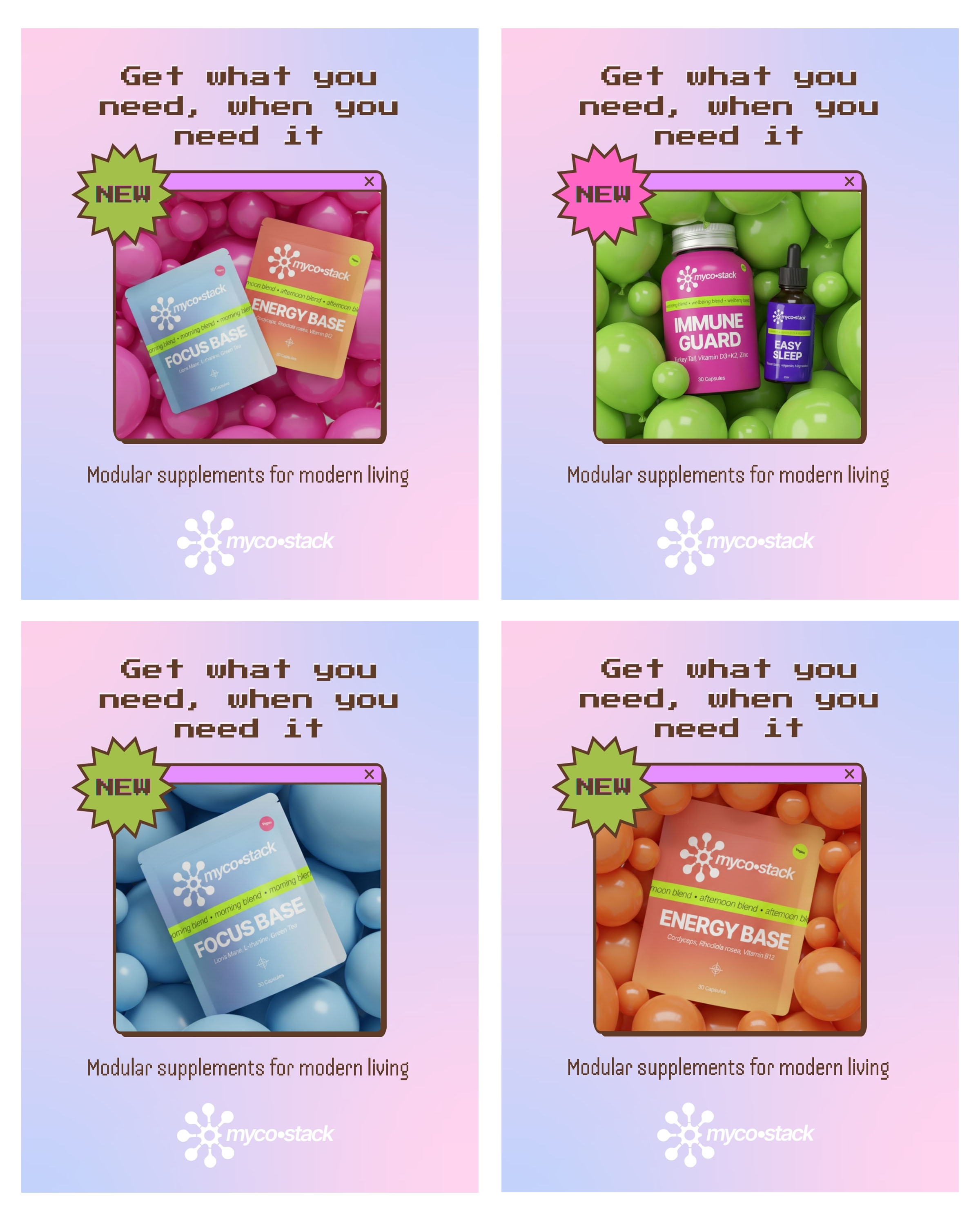
mycostack control ads
Loops Optimised Ads
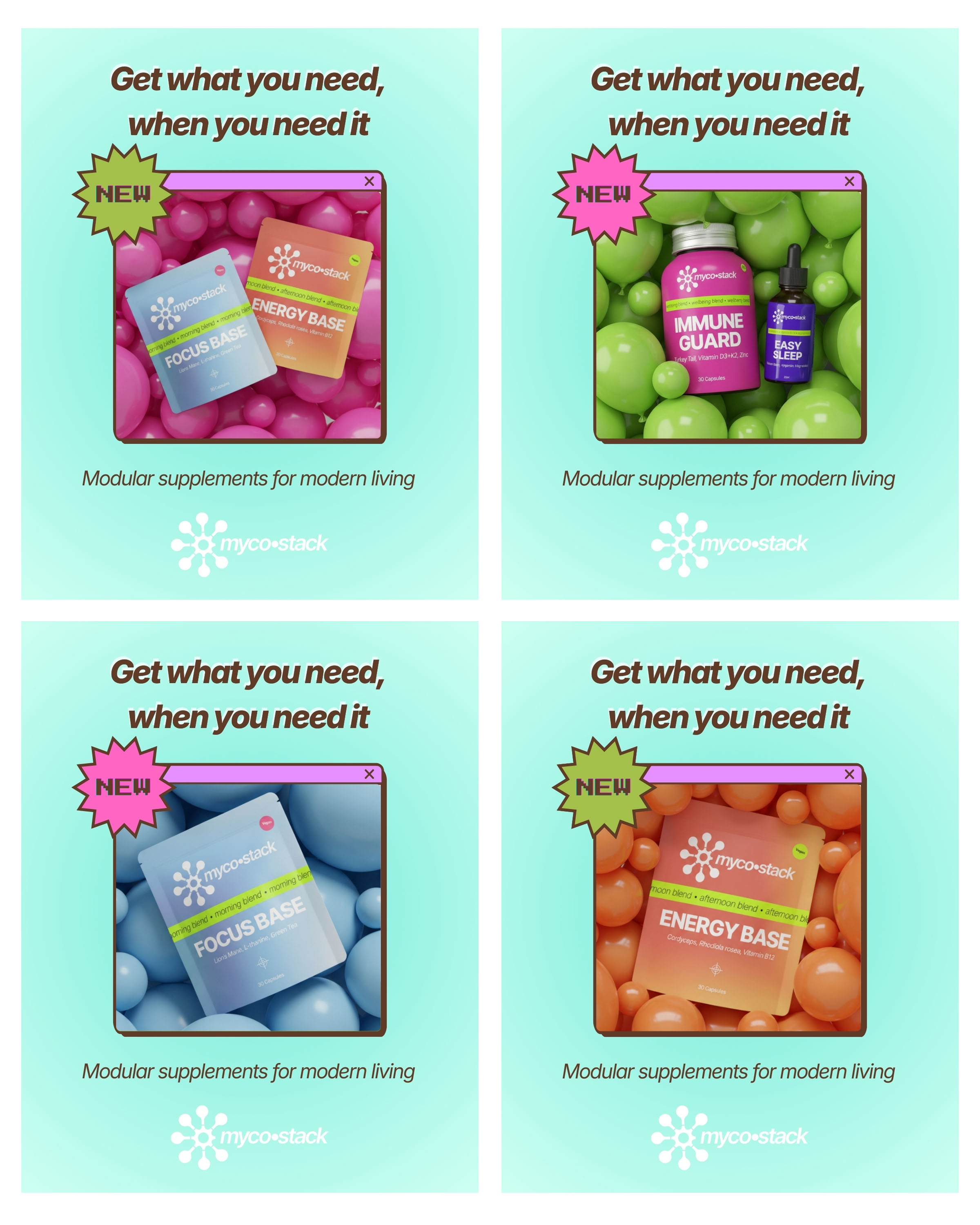
mycostack Loops optimised ads
For myco•stack, 150 respondents were shown all four static versions of the ad and asked for feedback on creative elements of the ad and accompanying copy to gather how the ads could be improved to be more engaging.
Responses suggested that the background colour should be changed and that the pixelated font in the ad did not convey that the product was a health supplement.
Impact:
Meta | Impressions | Clicks | CTR | CPC | Conversions | Conv Rate |
Control | 12,085 | 209 | 1.73 | 1.48 | 77 | 0.64 |
Optimised | 14,556 | 217 | 1.49 | 1.25 | 97 | 0.67 |
26% increase in conversions
18% reduction in CPC
5% increase in conversion rate
What This Means For Marketing Budgets
Across three brands, with unique audiences and a range of creative types and placements, Loops was able to demonstrate measurable increases in creative performance that would deliver significant ROI improvements in real-world settings.
The myco•stack brand was the worst performer; however, the results show only a small variation in conversion rate across creative, suggesting that the landing page had issues which, in a real-world scenario, would warrant further testing. Even with this, there was a moderate but not insignificant increase in conversions and a reduction in cost per click.
Both ZenBlend and GlowLab saw exceptional improvements across all performance metrics, as well as a reduction in costs that could deliver a significant alternative to the traditional testing methodology used across performance marketing.
Averaging all three experiments showed that pretesting ads in Loops can produce:
235% increase in conversions
43% reduction in CPC
205% increase in conversion rate
A New Performance Marketing Playbook?
The results show more than incremental gains - they demonstrate a significant opportunity for marketing teams to turn wasted spend into revenue.
In practice, that brand with the £50,000 p/m hoverboard campaign we discussed earlier could eliminate their entire £5k-£10k learning phase. Instead of giving that budget to Meta or Google to discover which ads work, they invest a fraction of that cost in testing with matched consumers in Loops, then launch with creative they already know will perform.
But the benefits extend beyond just saving the testing budget:
From day one, you're spending on winners. No ramp-up period. No wasted impressions on underperforming creative. Your first pound spent performs like your best pound spent in traditional campaigns.
You can test more, faster. Without the budget constraint of platform testing, you can explore more creative directions, test bolder concepts, and iterate rapidly, all before spending campaign budgets.
You compound improvements over time. Each Loops test builds your understanding of what resonates with your audience. These insights inform not just individual campaigns, but your entire creative strategy.
You gain a competitive advantage as AI scales creative production. As generative AI makes it possible to create hundreds of ad variations, the bottleneck shifts from production to validation. Loops lets you identify winners from massive creative libraries without the massive testing budgets.
The traditional performance marketing model was built in an era when testing on platforms was the only option. That era is over.
Ready to Transform Your Creative Performance?
The data is clear: pre-testing creative with real consumers in Loops doesn't just save budget, it dramatically improves campaign performance from the first impression.
If you're spending tens of thousands learning which ads work through platform testing, you're not just wasting budget. You're giving your competitors who pre-test a 235% advantage in conversions and a 43% advantage in cost efficiency.
The question isn't whether this approach works. The question is: how much longer can you afford to keep testing the old way?
Book a demo today and start testing smarter with Loops. Get rapid feedback from 110M+ consumers and launch campaigns that win from day one.